Tag Archives: leaving cert english

Topic of the Week: Plagiarism

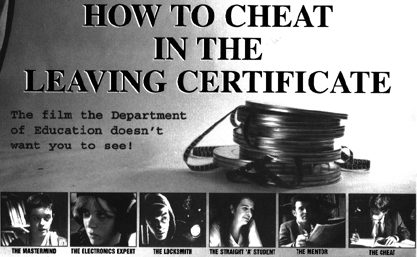
I’ve found myself thinking about plagiarism a lot since I started this website. There’s not much confusion about what it is – taking someone else’s language, thoughts, ideas or expressions and passing them off as your own – but there seems to be no consensus anymore as to whether or not it’s ok. Particularly when it comes to the leaving cert.

The major problem lies in the sheer volume of information your average teenager is expected to hold in their brain in order to sit this exam. If the teacher doesn’t provide a no nonsense, here are the essentials, forget about real learning synopsis of every aspect of the course, students and parents will look elsewhere. And who can really blame them? If it’s possible to fake knowledge and understanding and thus achieve an impressive set of results and entry into your college course of choice, why wouldn’t you? If there’s one thing we know about human beings, it is this. We do what works. If there’s a shortcut, we’ll take it.

So does rote learning work? In the short term, possibly, and it really depends on the subject. In the long term, not at all. You’ll go to college and suddenly independent thinking, critical analysis, originality and initiative are all expected of you. In fact I frequently hear college lecturers bemoan the months of effort they have to put into de-programming first year college students from the rote learning that has become second nature to them in secondary school. My focus on turning my students into better writers sometimes drives them to utter despair but a robotic ability to learn off reams of facts is not something I can ever or will ever view as anything but pointless.

There is no easy solution. Continuous assessment is wide open to plagiarism – you get your uncle the carpenter to do your woodwork project and voila, you’ve got an A. Reforming college entry is an obvious starting point – if you take away the points race, you remove the pressure on students and teachers to teach/learn to the test – but this solution is also riddled with problems. How else do you decide who gets into college? A lottery? Finally, reducing the number of subjects students study seems an obvious step forward, but is it right to narrow their exposure to the world of knowledge and ideas so early? And will students again just choose the ‘easy’ options? We already have a massive problem with a lack of uptake in Maths, Science and IT. Do we really want to make things worse?

As for English as a subject, 75% of the Junior Cert and 55% of the Leaving Cert you will not see until you turn over and read the exam papers. You can rote learn until the cows moo loudly at dawn but if you don’t twist what you’ve learned to suit the question you will not do well. And most importantly of all, you must be able to write well. Perhaps years of sample answers you’ve been encouraged to learn off do you the greatest disservice of all, because they undermine your opportunities to practise constructing clear coherent sentences of your own.

Finally, be aware that Ruairi Quinn has recently been quoted critiquing our fondness for predictable exam papers that don’t require students to think laterally, apply knowledge or demonstrate understanding. I think in coming years the exam papers will get less predictable. Whilst that makes me feel sorry for those of you desperate to get into your chosen college course, on some level it does make more sense to offer a genuine challenge. If only the stakes weren’t so high, I’d feel more supportive of it.


Unseen poetry mistakes!

I recently came across a scrap of paper  written after correcting a bundle of unseen poetry tests. I may as well commit it to virtual paper before dumping it.

You need to remember the following:

  1. A quality response here will get you a lot more marks than sheer quantity.
  2. Divide your time equally between questions. Students often opt to answer two 10 mark questions (instead of one 20 mark Q) but then write a page long answer for (i) and three or four lines for (ii). It doesn’t take a genius to work out that getting 8 marks for (i) and 2 marks for (ii) (50% average) is a lot less effective than getting 7 marks for (i) and 6 marks for (ii) (65%).  Watch the clock. Take five minutes to analyse the poem, then 7 minutes to answer (i) and 7 minutes to answer (ii) – or just anwer the 20 mark question, writing for 15mins or so.
  3. Read the question carefully – know what’s expected when you’re asked to “write a response to the poem” (see here) and remember if you opt for the two 10 mark questions they’ll be asking you to focus on different aspects of the poem. If you find yourself saying the same thing for both answers THIS IS BAD!  One tip is to rewrite the question in your own words before you start to answer it. This makes you focus before you start to write.
  4. Remember poetry is the ultimate form of aesthetic language – this means that what you say is in many ways less important than HOW you say it. A poet is hyper-aware of the tricks and techniques they can use; aware that language has it’s own music and rhythm and flow. Thus you must identify techniques but more importantly say why the poet has chosen to use a particular technique – what effect do they achieve in using this particular technique???
  5. Zoom in on the poem. Look at the impact of individual words/phrases. A close reading of SOME (not all) of the poem is expected – but don’t worry about ignoring sections of the poem. You don’t need to offer a line by line analysis of the poem – in fact you shouldn’t – you couldn’t possibly in the time given.
  6. Don’t repeat yourself. If you say the same thing twice (even if you phrase it differently), the examiner will simply deduct marks because your answer loses its coherence as soon as you do this.
  7. Avoid slang. You should use FORMAL LANGUAGE for critical analysis – in the same way that you are expected to dress smartly for an interview, you are expected to ‘dress up’ your language for all of Paper 2 (in Paper 1 it depends on the task).

Anyway hope that’s of enough help that I was right to write it down before dumping that scrap of paper.


Topic of the week: Nostalgia

Nostalgia  … was it better in the old days?

Since time immemorial, the people of ‘today’ have always bemoaned the loss of the good ol’ days.  Supposedly, there’s even a piece of very early Greek writing with decries the invention of writing as the “death of oral culture”!

What is this about? Why, when the evidence of scientific, health and (most of the time) standard-of-living of human kind shows obvious, inexorable progress – that ‘today’ is better than ‘yesterday’ ever was – does human nature always tend to revere its past?

So whenever you next hear your parents or your elderly crazy Aunt tut tutting “…back in my day…when the world was in black and white…” and you find your eyes glazing over with boredom, remember this. Those who endlessly celebrate the ‘good old days’ have simply failed to find something worth doing in the present and have nothing to look forward to in the future. But don’t be annoyed with them. Pity them. Offer your compassion. They bloody well need it!

Sample Questions:

“Write a speech in which you attempt to persuade an audience that the past should not be glorified”

“Imagine that you have discovered a time capsule containing a number of items from the distant or more recent past. Write a letter to a local or national newspaper announcing your find & describing the items in the capsule”.

“Write a personal essay in which you explore some of your earliest memories of childhood”.

“You have been asked to give a short talk to a group of students who are about to start first year in your school. Write out the text of the talk you would give”.

Introductions & Conclusions

Think of your introduction as a road map. You have been given a destination (the question) and there are lots of perfectly acceptable ways of getting there. In your introduction you lay out clearly what directions you’ll take in your essay. Your conclusion is where you look back on the highlights of your journey and recap on what you have learnt along the way!

INTRODUCTION: MAKE SURE TO USE THE WORDS FROM THE Q – but don’t begin by simply parroting back the question word for word. There is nothing worse than the predictable “I agree 100% that…..”. You could begin with a quote and/or with a dramatic statement and you must engage with the question asked.

Each introduction needs the following:

  • Thesis (main idea) = eg. Plath’s poetry is filled with the fears we all share.
  • Main topics to be discussed = (1), (2), (3)
  • Answer the Question = PR – my personal response (sentences using “I” or “me”)

Imagine the question is “Plath’s poetry offers us a frightening yet fascinating insight into her personal demons

Sample introduction:

(Thesis) Plath’s poetry captures the fear in the heart of us all. Fear of failure, fear of unhappiness, fear of hitting the bottom and being unable to claw our way back to sanity. (1) In the poems “Morning Song” and “Child”, Plath is afraid that despite her best intentions she is will not be a good mother to her children. (2) In “Mirror” and “Elm” she fears that her depression & disappointment with life will destroy her. (3) In “Pheasant” and “The Arrival of the Beebox” she worries that power corrupts people in frightening ways. (PR) I found this exploration of human fears and insecurities in her poetry both fascinating & disturbing.

CONCLUSION: MAKE SURE TO USE THE WORDS FROM THE QUESTION but don’t simply repeat what you said in the introduction and don’t introduce new ideas.

Each conclusion must:

  • Link the last paragraph to the first.
  • Repeat the thesis (main idea) but rephrase it.
  • Taking each idea in turn (1. motherhood, 2. depression, 3. power) say what you learned from studying each issue & this poet in general. By doing this you will be showing how you have proved your thesis/answered the Q

 Sample conclusion:

(Thesis) Thus we see that Plath’s poetry begins in fear and ends in fear. Yet studying her poetry and getting an insight into her personal demons was for me an uplifting as well as a depressing experience. (1)I personally admired her determination to provide only the best for her children and learnt that parenting can involve many difficult challenges. (2)I found her exploration of the loss of youth in Mirror and the loss of love & sanity in Elm truly disturbing, but in a positive way these poems encouraged me to avoid putting pressure on myself to be ‘perfect’ in appearance and behaviour. (3) Finally, Plath’s poetry challenged me to avoid exploiting the power I have over nature and to have a greater respect for the environment. Accompanying Plath on her journey to the bottom was not easy but I learnt a lot about life on the way and I would strongly recommend her poetry despite it’s difficult subject matter.

Some obvious things that need to be said:

Don’t put in the bits in bold/brackets – I’m just putting them in to make it really obvious what each sentence is doing.

This is a good introduction and conclusion FOR THIS PARTICULAR ESSAY TITLE. But don’t be rubbing your hands together in glee, saying ‘yey, I’ll just learn off this introduction and conclusion and write them if Plath comes up‘ – you can’t write a definitive introduction and conclusion in advance because you don’t know what the question will be until you open the exam paper. And you MUST answer the question. And there’s also the not so small matter of plagiarism to consider!

Studied poetry: mistakes.

  1. Ignoring the question: if you are asked for a personal response to a poet’s work, every paragraph must contain at least two sentences which include the word “I”. If you are given a statement to discuss, keep using the words from the question (and synonyms) and showing how what you’re discussing is relevant to the question asked. Don’t just rewrite the question at the end of every paragraph and hope this will do – it won’t!

  2. Writing the name of the poem incorrectly (or worse getting the name of the poem wrong!). When you write the name of a poem, use capital letters and quotation marks eg “The War Horse”, “A Constable Calls”

  1. Lack of quotes! The sure sign of a bluffer. Quotes provide proof that you

    (a)know the poems and (b) can back up any statements you make with concrete evidence.

  1. Quotes at the beginning of sentences/paragraphs. Never write down the quote and then comment on it. This suggests you’re just throwing the quote on the page and then making up something to say about it. Bad idea! The rule is statement FOLLOWED by quote. This way you show you are in control of what you want to say.
  1. Telling the STORY of the poem – sum up what the poem is about in ONE or two sentences. Leave it at that. Your job is to analyse the way the ideas are expressed (techniques), the feelings the poem contains & creates in you, the way ideas recur and develop from poem to poem. Comment on the ideas rather than just saying what ideas the poem contains.

  1. Lack of personal response! You need to show that studying this poet has changed your perspective on life, taught you something valuable, opened your eyes to an issue you had previously ignored, provoked an emotional response, connected to something in your own life. Your job is to convince the reader that this poet is worth a closer look. However, don’t ramble off on a tangent about yourself (there was this one time, at band camp… yawn!). Ultimately you are offering a detailed analysis of the poetry, not a diary of your life. A good rule of thumb is to confine personal response to two sentences per paragraph.

  1. Long rambling sentences, paragraphs that sprawl to over a page, pointless repetition. Try to form the sentence in your head before you write it down. DO NOT vomit onto the page. If you can say what you need to say neatly and concisely in 2 sentences instead of 6 – DO. Try to avoid saying the same thing a couple of different ways. Make your point and move on. The examiner is looking for economy of language: each sentence is crammed with information; no idea or quote is ever repeated; essay is carefully structured into neat paragraphs; linking phrases are used to create flow from idea to idea and from paragraph to paragraph.
  1. Poem by poem analysis which doesn’t establish links between them – you are giving an overview of the poet’s work, showing how the poems fit together, analysing common themes or recurring techniques. Do not just write three mini essays on individual poems. Link them! Each paragraph should begin with a topic sentence. This topic sentence can be thematic, stylistic or tonal.

e.g. THEMATIC = “Boland explores historical events from a deeply personal and individual viewpoint”

e.g. STYLISTIC = “Eavan Boland makes wonderful use of contrast in many of her poems, to bring each issue she deals with into sharper focus”

e.g. TONAL = “Boland masterfully evokes the depth of human suffering in her poems”