Tag Archives: leaving cert english

What the heck is GV&V ?

Lots of students – and teachers if we’re honest – struggle to define the concept of general vision and viewpoint. It can seem kind of vague and wooly beside the others modes, which are pretty straightforward once you get a grasp of them.

I guess there are two main elements to gv+v
Element one: first let’s think about the person who creates the text. When a writer writes a book or a play or directs a film they have a particular view of the world and of the human beings who live in it! In really really simple terms, if their stories always have a happy ending, if the characters triumph over adversity, if true love conquers all, if good is rewarded and evil punished, then the vision of the world they offer is positive and their viewpoint is optimistic. Very few texts will be this straightforward however. Often bad things happen to good people in texts and the vision never stays the same the whole way through – but we’ll come back to this later!
For now though, let’s keep it simple!
So as described above the first element to gv&v is created by the writer.
The second element however is something the writer cannot control – and this is the way the reader/viewer responds to the vision they have created. I, for example, don’t like romantic comedies. I think they are formulaic, predictable, simplistic and sickly sweet. So even though the person who wrote it might want me to respond positively to the vision they are offering, I probably won’t.
Now let’s look at a specific exam question:
“THE GENERAL VISION AND VIEWPOINT IS SHAPED BY THE READER’S FEELING OF OPTIMISM OR PESSIMISM IN READING THE TEXT”. IN LIGHT OF THE ABOVE STATEMENT, COMPARE THE GENERAL VISION AND VIEWPOINT IN AT LEAST TWO TEXTS YOU HAVE STUDIED IN YOUR COMPARATIVE COURSE.
I think the wording of the question might be confusing at first. Keep this in mind – ultimately YOU decide what vision of the world is being offered. Thus you could write this sentence in your essay: “In my opinion, the director offers a very romantic and idealistic vision of relationships in the scene where……..(fill in specific details) but I personally find this viewpoint overly simplistic and cliched. He wants the viewer to be swept up in the drama, and uses a sweeping violin score to achieve this, but I found myself rolling my eyes rather than sighing wistfully“.
And then of course you have to tie this into another text, and then another. To see how this is done, have a look at my post “Cracking the Comparative
You may also have noticed a third, related element to gv&v which is HOW the vision is communicated. This refers to HOW the mood and atmosphere is created – for example through close-ups of facial expressions, through music, through symbolism, through flashbacks (to create nostalgia or to add backstory), through the relationships between characters & how they treat each other, through the way the society is presented to us in a positive or negative light.
Bearing all of this in mind, what kind of questions can you be asked?
  • A straightforward question will just ask you to discuss the writer’s viewpoint (element 1).
  • A slightly more complicated question will ask you to focus on your feelings – on how you respond to the view offered by the writer/director (element 2).
  • A variation on a simple vision question is one which asks you to discuss the writer’s view and look at how this is communicated to the reader (a combination of element 1 and element 3).

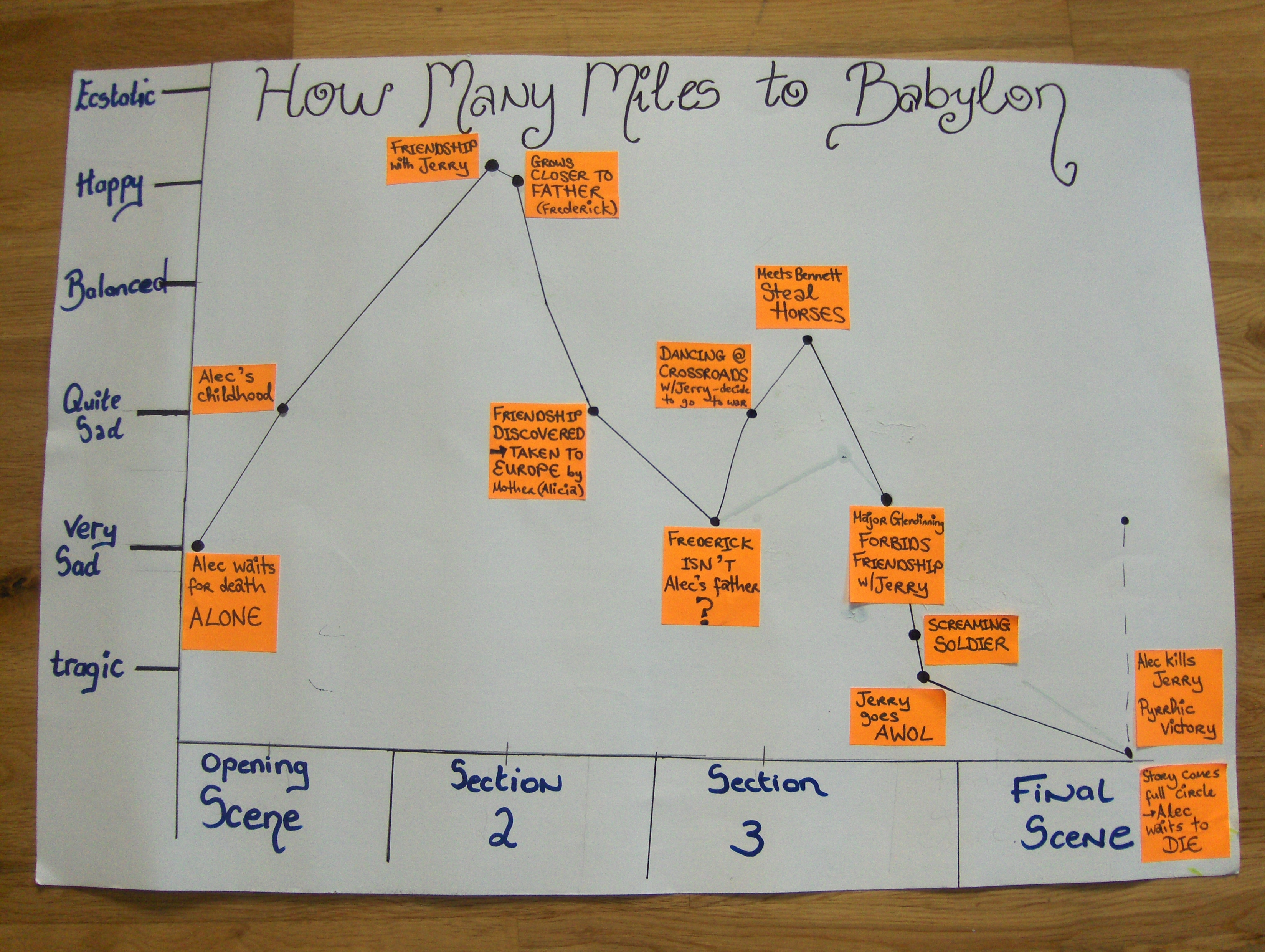
As I mentioned above, the gv&v changes during the course of any text. One exercise I did with my class was to draw up a graph – see photo above. The vertical axis went from tragic at the bottom to blissfully happy at the top. The horizontal axis went from the beginning (on the left) to the end (on the right) of the text. Then we picked maybe eight key moments and plotted them on the graph. This gave us a clearer sense of how the gv&v changed, ebbed and flowed over the course of the text from beginning to end. However it is a little simplistic – you need to offer a more complex discussion  than “happy/sad” (nostalgia, longing, frustration, injustice, tragedy, triumph, humour are all more specific words that spring to mind!) AND you need to think about whether the author offers you a positive, fond and uplifting view of human beings or a deeply pessimistic indictment of human beings’ flaws and foibles. Think about the writer/director’s vision of the society the characters inhabit. What decisions has the writer/director made as to how the text begins and ends. Does the story begin and end at the same point (as in Babylon)? Have the characters achieved anything in the intervening period? Is the text a gradual journey towards enlightenment and self-fulfillment? Or does everything end badly, despite the characters best efforts to achieve happiness?
Because the concept is quite multi-faceted, try to simplify your overall essay structure.
Compare the beginning gv&v of each text.
Then compare gv&v about a third of the way in.
Next compare gv&v about two thirds of the way in.
Finally compare the gv&v of the endings.
And of course the most important thing is to tie them together in the way that I described in the post “Cracking the comparative“.
Hopefully that will clarify things somewhat!

Topic of the Week: Being Irish!

What does it mean to be Irish? It means we drink too much, swear too much, shout at the telly (especially when there’s sport on), love Taytos, have at least nine cups of tea a day, talk about the weather all the time (but none of us own a rainjacket!), have the Irish mark (left shoulder, two dots) and at least two scars from where we picked at our chicken pox, squirm whenever someone pays us a compliment (“this jacket? I got it in Penneys for a tenner“), love pub quizzes, love curry chips, love Fr. Ted, secretly wish we could win the Eurovision just one more time, think RTE is shite (but still watch it), think the Rose of Tralee is shite (but still watch it – but only because our parents have it on!), think Winning Streak is shite (it is – but still watch it when one of the neighbours is on!). We don’t like boastin’ though so I can’t tell you that we’re great craic, fierce loyal, give heaps o money to charity and wouldn’t see ya stuck if you were havin a rough time of it. ‘Cause if I said all that you might think I was gettin’ up meself like!

Sample exam questions:
2008
Write a speech in which you argue for or against the necessity to protect national culture and identity.

2007
Imagine you have a friend in another country which is considering the introduction of a ban on smoking in public places. Write a letter to your friend advising him/her either to support or not to support the proposed ban. In giving your advice you may wish to draw on the recent experience of the smoking ban in Ireland.

2001
Write a personal essay in which you explore your sense of what it means to be Irish.

2001
You have been elected President of Ireland – write the first speech you would make to the Irish people.

2001
Write a letter to Martin Mansergh in which you outline your response to his view of young Irish people.

Tips for Hamlet

[youtube_sc url=http://www.youtube.com/watch?v=t0CqUTmwKiM#!]
“I am having real trouble getting my ideas in order in Hamlet answers and writing strong opening and closing paragraphs…any advice that could help me please :)”
I’ve just received this email and I figure I might as well share my reply with all of you, as this is a common problem I come across. Often students know Act 1 of their Shakespearean play so well that they write over two pages on it. And then cram all of Act 2, 3, 4 and 5 into a page and a half. Not really a good idea.
So here is the reply I sent:
Hi _____,

Well first off, you are not alone. Mastering the skill of writing good introductions and conclusions is very difficult. It’s made worse by the fear of knowing that you MUST ENGAGE fully with the question – so you can have an idea of what you want to say in general if a question comes up on a particular theme or character but you cannot know exactly what words you’ll use until you see the question asked.
Last year for example lots of students were prepared for a question on the theme of revenge but they had to change their ‘prepared’ answer significantly because the question that came up asked to you discuss revenge and justice together. If they just wrote what they’d prepared and ignored the question they didn’t do very well.
Anyway, if you click here http://leavingcertenglish.net/2011/04/hamlet-plot/ you can download a couple of sample paragraphs on specific Hamlet questions.
Also if you follow the rules here http://leavingcertenglish.net/2011/12/introductions-conclusions/ but apply them to the play instead of the poetry you should get a clear sense of what actually goes into an introduction and a conclusion.
If you want to get your ideas in order write down this checklist when brainstorming ideas. It doesn’t work for some questions (e.g. specific question on Ophelia or a question on soliloquies) but for most questions on Hamlet, general theme questions or open questions on the entire play it might come in handy.
10 most important ‘checkpoints’ in Hamlet
1. Court scene
2. Ghost scene
3. Nunnery scene
4. Player’s play
5. Prayer scene
6. Closet scene
7. Ophelia’s madness
8. Laertes return / manipulation by Claudius
9. Graveyard scene
10. Final scene
Hope that helps!
Evelyn

Cracking the comparative ;-)

If this is how you feel when you think of the comparative, you are not alone, so don’t panic. I’ll try my best to simplify what is actually the most complex essay structure on the course.

There are two fundamental errors you’re in danger of making when writing your comparative answers.

1. You fail to answer the question.

2. Your links are weak and superficial.

It’s impossible to know what the question will be until you open the paper, but if you want to see what type of questions generally come up, click here on ‘Theme or Issue questions‘, ‘Literary Genre questions‘ and ‘General Vision and Viewpoint questions‘ (note: these are the modes for 2012, they’ll be different if you’re doing the leaving in 2013).

So let’s imagine the question is “What did you enjoy about exploring the general vision & viewpoint of the texts you studied?”

This is the kind of answer that will get you a D2:

“I really enjoyed studying the general vision and viewpoint of my three texts. The opening scene of DAL is quite nostalgic as Michael looks back on his childhood in Donegal but it’s also pessimistic because he says things weren’t really what they seemed and he mentions Fr. Jack coming home but not being nearly as impressive as they expected. We then see the Mundy sisters together, they are a close family but Kate tends to boss them around and the others resent this, particularly Agnes. When she decides they can’t go to the harvest dance the sisters are pissed off but Kate thinks it wouldn’t be right. Similarly the opening scene of IID is quite pessimistic. Michael sits on his own in Carrigmore home for the disabled and he can’t communicate because he is handicapped and can’t speak properly. He tries to warn one of the workers that there’s a cable that might get snagged and someone will trip but they don’t understand what he’s trying to say. He seems really frustrated and I would hate to be in his situation. The first scene in HMB is also pessimistic. Alec is waiting to die and he won’t get in touch with anybody in his family to tell them what’s happening. He doesn’t seem to even care and when the priest comes in he sends him away after making jokes about his own death. So I enjoyed seeing how awful some people’s lives can be because mine is way better and that made me happy”

Before you read on, I made up this answer. So no I’m not slagging off a real student’s work.

What’s wrong with this answer? Let me count the ways:

  1. Question is thrown in at the beginning and end of the paragraph but no effort is made to actually engage with the question.
  2. Sentences go on – and on – and on. The writer clearly has no control over what they’re trying to say. It comes out as a stream of consciousness ‘vomit’ onto the page.
  3. Informal conversational language and slang “she bosses them around” “pissed off” “he doesn’t even care” “mine is way better”
  4. Inaccurate and vague details: “handicapped” instead of “cerebral palsy”, “can’t speak properly” instead of “has a speech impediment”, “he says things weren’t as they seemed” instead of including the quote “I had an awareness of a widening breech between what seemed to be and what was”, reference to the “priest” instead of the “padre”.
  5. Texts dealt with separately with superficial links barely established “similarly” “also”.
The simplest way for me to explain why this is the greatest mistake you can make is through a knitting analogy. Have a look at this stripy jumper:

Each colour is knitted separately. They only touch briefly.

Now let’s say white represents the times when you’re talking about all three texts.

Dark grey represents DAL.

Light grey represents HMB.

Purple represents IID.

Each section exists on its own, never mingling with the other colors, only briefly linking with them, perhaps for a line or sometimes just for a single stitch (or ‘link’). All of the ingredients are there but they never get mixed up together. In fact you could just take out each color and knit four separate jumpers if you wanted to.

Now let’s have a look at how to do it properly:

“Studying the general vision and viewpoint of my three texts offered me a fascinating insight into the quiet lives of desperation many people lead and I found myself on tenterhooks, rooting for the central characters as they attempted to create a better life for themselves. The opening scene of DAL is full of nostalgia as Michael the narrator launches into a flashback of the summer when Fr. Jack returned from the missions. Despite the closeness of the family unit (Michael remembers his aunts dancing wildly to the music from the wireless) there is an aura of mystery and foreboding, an awareness “of a widening breach between what seemed to be and what was”. This aura makes DAL in many ways similar to HMB (from the beginning of both texts the reader feels something bad is about to happen) but the atmosphere of fear and foreboding are much more pronounced in HMB. The opening scene fills us with unease as Alec waits to die. Unlike the Mundy sisters (DAL) we have no sense that he feels close to his family – in fact he bluntly admits “I love no living person, I am committed to no cause…I have not communicated with either my father or mother”. I found his indifference to his plight deeply unsettling. Thus although I felt compelled to read on, I cannot say I ‘enjoyed’ watching him suffer. The same is true of IID, where the central character’s difficulties fill the reader with sympathy. Michael’s cerebral palsy and speech impediment isolate him from the other residents but what makes this film subtly (yet significantly) different to HMB is that in IID we can see Michael’s frustration, through a series of close-ups of his face as he tries to communicate with Eileen and warn her of the impending accident (he has seen a vacuum cable snag and knows it will trip someone up). By contrast Alec (HMB) expresses no desire to escape the awful situation he finds himself in. Yet there are also interesting similarities between HMB and IID , for example the complete lack of family support and in some ways this makes DAL the most positive of the three – no matter what their difficulties at least the Mundy sisters have each other.  Thus I can honestly say that all three texts captured my imagination, roused my curiousity and engaged my sympathy for the central characters in the opening scene, thus adding to my enjoyment and compelling me to read (or watch!) on.

Why is this so good by comparison?

  1. The question is fully engaged with throughout by the writer.
  2. Sentences are complex but highly controlled (writer uses brackets if adding something significant that would make the sentence unwieldy).
  3. Formal language of critical analysis is used at all times.
  4. Details are accurate and specific, including occasional use of quotes (perhaps four or five in total in your essay is more than sufficient).
  5. Texts are interwoven; links are complex, recognising obvious similarities and differences but also going further to establish subtle distinctions.

Again the knitting analogy is useful.

This pattern also has all of the ingredients necessary but if you look at the body of the jumper (ignore the sleeves) you’ll see that the person knitting this jumper begins a line with one color but then switches to another – or sometimes switches to a different colour for one line but then switches back again.

In your essay the texts need to be interwoven in this way. You need to establish complex links. You can keep your basic pattern – I’ll mostly discuss DAL, then HMB, then IID – but you must be willing to link them in subtle and meaningful ways. If the examiner feels like they could easily separate your essay out into three separate essays (unravelling this jumper would be a lot more complicated than unravelling the one above) then you have a problem.

With ONE NOTABLE EXCEPTION.

If you chose to answer a 30 / 40 mark split you will deal with one text entirely on it’s own.

 So let’s say this cream jumper represents DAL.

You completely ignore the other two and just discuss DAL on its own.


Then when you move on to the 40 mark discussion of your other two texts (HMB and IID in this example) you weave the two texts together. In this example, the charcoal can be HMB and the light grey can be IID. You can occasionally refer back to DAL (cream) but not in any great detail.

Pay attention to how the question is phrased. If it says “in the light of your discussion above” then you must deal with the same ideas, issues etc.. If it doesn’t you don’t have to – but it’s probably easier.

I have no idea if that makes things any clearer but I don’t know any other way to make you aware of how important it is to have interwoven your texts together, rather than simply treating them as three separate entities. Ultimately, answering the question asked and having in-depth quality comparisons (both similarities and differences) make the difference in doing well or doing badly in comparative studies.


Hamlet’s soliloquies

I don’t propose to offer a lengthy discussion of every soliloquy in the play. You can do that yourself. Or google it!

Rather, I’d like you to consider the following:

There are 7 soliloquies delivered by Hamlet and one by Claudius.

The purpose of the soliloquies is to reveal more about the thoughts, feelings, personality and mindset of the central character(s).

In the case of Hamlet, without the soliloquies, his behavior would make absolutely no sense. His father has been murdered and then reappears in the form of a ghost, ordering him to get revenge, restore order to the Kingdom and claim what is rightfully his – the throne. So if we weren’t aware of the moral and emotional turmoil going on inside his heart and soul, if we didn’t know that his mind was a constant battleground, we would not sit through this play. In fact we would probably boo at the central character and possibly even start taunting him for his inaction and cowardice.

Bearing all of this in mind, in the case of each soliloquy you could do the following:

CONTEXTUALISE – when is it delivered? What happens immediately beforehand? Does this prompt the ‘outburst’ of the soliloquy?

ANALYSE – what exactly is revealed from what the character says in each soliloquy? In the case of Hamlet we see that he is

(a) highly self-critical (this links in to the idea that he is a very self-aware tragic hero – unlike Lear, Hamlet is aware of his fatal flaw from the outset)

(b) morally aware (this links in to the idea that he is a very noble person whose delay is partially due to his desire to ‘do the right thing’ (he double-checks that Claudius is actually guilty) and partially due to his profound sense that violence is wrong (even if he would be obeying a powerful code of honor and revenge when engaging in this violence).

(c) deeply philosophical (his tendency to over-think things leads to his suicidal depression and also contributes to his inaction. One benefit emerges, however, in the beauty of the language created by Shakespeare to consider some of the greatest moral, spiritual and philosophical ideas known to humankind. Without these soliloquies the world would be a lesser place. And I mean that sincerely).

PERSONALISE

Can you identify the effect of Hamlet’s soliloquies on the audience? Most obviously, they allow us to identify him as the ‘hero’ of the play. Secondly they give us an insight into his thoughts and thus allow us to understand him on a deep level – otherwise we’d just be shouting ‘get on with it’ at the stage and possibly throwing things too! Finally, they allow us to sympathize with his plight, even to emphatise on some levels – yes I know none of us have ever had to avenge our father’s murder and kill our Uncle for shagging our mother, but we can emphatise with the idea of feeling obliged, even compelled to do something but being unable to muster up the will to actually do it (generally speaking that might be washing dishes, doing homework or breaking up with someone. Not quite as dramatic as what poor Hamlet is going through).